
Header Image

White Shark off the coast of South Africa
Sunday, January 26, 2014
*Update*
According to 9NewsPerth, protesters have admitted to going out overnight and removing bait from some of the drum lines in WA.

Maryland Shark Finning Ban
Hello all,
The state of Maryland is proposing a new policy that will weaken its ban on shark finning. The state is accepting comments from the public on the policy. David Shiffman, of the RJ Dunlap Marine Lab, has written a post explaining how you can help stop this from going through. Please click the link below and read through his post carefully, following the instructions.
Thank you
http://www.southernfriedscience.com/?p=16498
The state of Maryland is proposing a new policy that will weaken its ban on shark finning. The state is accepting comments from the public on the policy. David Shiffman, of the RJ Dunlap Marine Lab, has written a post explaining how you can help stop this from going through. Please click the link below and read through his post carefully, following the instructions.
Thank you
http://www.southernfriedscience.com/?p=16498
Saturday, January 25, 2014
First Fatality of WA Shark Cull
Word has just been received that the first fatality of State Premier Colin Barnett's shark cull is a 3 meter Tiger shark. The animal was baited on the drum lines, shot several times, and is being dragged out to sea. For those that do not know, tiger sharks are listed as Near Threatened on the IUCN Red List.
Updates will be made when further information is gathered. Until then, send out some positive thoughts that this disgrace of a mitigation policy will not claim any more innocent victims during the Australian summer.
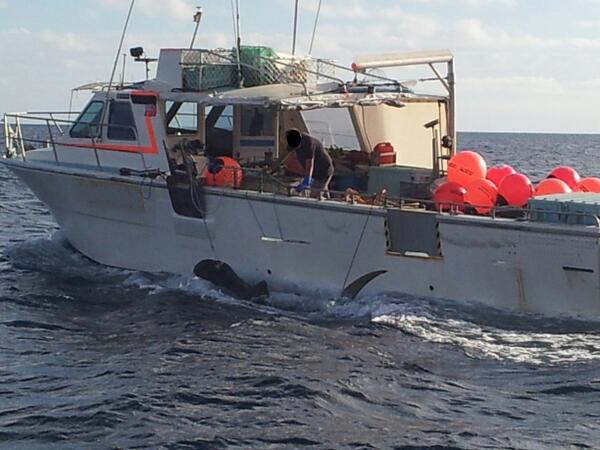
Photo source: 9NewsPerth
Updates will be made when further information is gathered. Until then, send out some positive thoughts that this disgrace of a mitigation policy will not claim any more innocent victims during the Australian summer.
Photo source: 9NewsPerth
Saturday, January 4, 2014

Friday, December 27, 2013

Wednesday, December 25, 2013

Monday, December 23, 2013
Australia’s Shark Mitigation Policy Misses the Mark

This article written by me for plantingpeace.org
In response
to a rise in the number of fatal shark incidences off the coast of Western
Australia in the last two years, the state Premier Colin Barnett has ordered a
cull of all large sharks within close proximity to beaches. These “safe zones”
will contain strategically placed drum lines (baited hooks attached to drums)
that are monitored daily, and will solicit the help of commercial fisherman to
hunt and remove sharks larger than three meters. Species targeted by this act
could include the tiger, bull, and state-protected great white.
The question
by many scientists and activists is whether or not a cull of large sharks would
in fact make the beaches safer; if judging by previous culling attempts, the
answer is no. Between 1959 and 1976, for example, Hawaii killed 4,668 sharks around the islands. According
to the Hawaii Institute of Marine Biology, however, this hunt had no noticeable
effect on the number of bites.
Oftentimes
the argument that favors a lethal solution to shark encounters is one based on
emotion, one that begs the question of whose life is more valuable: the human
or the shark. This is an ineffective way of thinking. Instead, there needs to
be additional funding put towards research to understand where the sharks are
coming from, how often they pass through the areas closer to shore, and what
factors contribute to a person being bitten.
Other
alternatives that could prove more effective are spotting programs, such as
Shark Spotters in South Africa, or a shark relocation program, such as in
Brazil. Shark Spotters was
initiated in South Africa in response to an increased number of great white
sharks being seen closer to shore. It was put into place in an attempt to
balance the needs of both the beachgoers and the sharks. The program uses a
series of flags to warn patrons of an increased possibility of a shark
encounter. A green flag means that spotting conditions are good; a black flag
means spotting conditions are poor. A red flag means there is a high alert for
sharks; a white flag means a shark has been spotted.

After an
increased number of fatal shark bites off of Recife, Brazil, the government
enacted an unconventional approach to shark mitigation. The Shark Monitoring
Program of Recife (SMPR) removes dangerous sharks by capturing,
transporting, and releasing them offshore. This kept the danger to swimmers
minimal while keeping the shark population healthy. While this program has been
in effect, there has been a 97% drop in shark incidences.
There are
several alternatives to culling endangered and vulnerable species to protect
the lives of swimmers and surfers. If you would like to voice your opinion and
let the WA Government know that what they’re planning to do is ineffective,
please sign the petition written by marine zoologist Dr. Barbara Wueringer by clicking the
link below: http://www.change.org/petitions/the-australian-senate-prevent-proactive-killing-of-white-sharks-in-australia-2
Friday, December 20, 2013

Friday, December 13, 2013

Saturday, December 7, 2013
31 New "Hope Spots" Announced
Her Deepness, the fabulous Sylvia
Earle, along with Mission Blue and IUCN, have announced 31 new "Hope Spots" at IMPAC3 (Third International Marine
Protected Area Congress). A Hope Spot is an area of ocean that warrants special
protection because of its diversity in marine species and underwater habitats.
These marine protected areas allow the ocean space to recover away from human
interaction. While less than one percent of the ocean is formally protected,
the goal of Mission Blue and IMPAC3 is to deliver the tools necessary for
implementing the protection of ten percent of the ocean by 2020. A lofty, but
necessary, goal.

Photo
courtesy of Mission Blue
These thirty-one new areas are in addition to the nineteen already in place by Mission Blue across the globe, a step experts say is necessary for a sustainable ocean future. The new MPA's include places such as the White Shark Cafe in the Pacific, the Scott Islands in Canada, and the Central Arctic Ocean.
In her award-winning 2009 TED talk, Dr. Earle stated, "I wish you would use all means at your disposal – films, the web, expeditions, new submarines, a campaign! – to ignite public support for a network of global marine protected areas, hope spots large enough to save and restore the ocean, the blue heart of the planet.” ---The blue heart of the planet. No statement has ever been closer to the truth. With the tremendous effort put forth by ocean pioneers such as Sylvia and Mission Blue, her wish is that much closer to coming true.
For more information on Mission Blue and a complete list of Hope Spots around the world, visit http://mission-blue.org/hope-spots-new/
Friday, December 6, 2013

Saturday, November 23, 2013
Blackfish
There has been a lot of buzz on social media in the last month regarding the documentary Blackfish, written by Gabriela Cowperthwaite. If you have not seen it, I thoroughly recommend it. To say this film is powerful does not do it justice.
Orcas are some of the most beautiful and intelligent animals on the planet. Blackfish discusses the issues of keeping such incredible animals in captivity. At the forefront of this film is Tilikum, a performing killer whale at Sea World in Orlando, Florida, who is responsible for the deaths of at least three people since the early 1990's.
I'll be honest, I'd never really thought much about animals in captivity. This could be due in large part to the fact that I've only ever been to aquariums, not to Sea World. When I saw this film for the first time, I was not only shocked, but also outraged and heartbroken. I felt an overwhelming sense of guilt; not only because of the unnecessary loss of human life, but because of the animals' lives as well. Mostly because I know that even if Tilikum were freed, he'd still be alone. Orcas are family animals; the young stay with their mothers throughout their entire lives. He never had that luxury. He was stolen from his family at two years old. Sadly enough, the human capacity for cruelty no longer surprises me.
When discussing this issue I was asked the question,"why should I care about a fish?" (Ignoring the fact that an orca is not a fish) This, in my opinion, is what is wrong with this world. Why should you care about a shark, or an orca, or a grouper? You should care because all life is precious, not just human life. Animals were not just placed here for human amusement; they serve a purpose too. One cannot simply exploit the oceans without consequence. To quote Sylvia Earle, "No blue, no green."
I've included the trailer for Blackfish. Please watch, and encourage others to do the same. Thank you.
Orcas are some of the most beautiful and intelligent animals on the planet. Blackfish discusses the issues of keeping such incredible animals in captivity. At the forefront of this film is Tilikum, a performing killer whale at Sea World in Orlando, Florida, who is responsible for the deaths of at least three people since the early 1990's.
I'll be honest, I'd never really thought much about animals in captivity. This could be due in large part to the fact that I've only ever been to aquariums, not to Sea World. When I saw this film for the first time, I was not only shocked, but also outraged and heartbroken. I felt an overwhelming sense of guilt; not only because of the unnecessary loss of human life, but because of the animals' lives as well. Mostly because I know that even if Tilikum were freed, he'd still be alone. Orcas are family animals; the young stay with their mothers throughout their entire lives. He never had that luxury. He was stolen from his family at two years old. Sadly enough, the human capacity for cruelty no longer surprises me.
When discussing this issue I was asked the question,"why should I care about a fish?" (Ignoring the fact that an orca is not a fish) This, in my opinion, is what is wrong with this world. Why should you care about a shark, or an orca, or a grouper? You should care because all life is precious, not just human life. Animals were not just placed here for human amusement; they serve a purpose too. One cannot simply exploit the oceans without consequence. To quote Sylvia Earle, "No blue, no green."
I've included the trailer for Blackfish. Please watch, and encourage others to do the same. Thank you.
Friday, November 22, 2013

Thursday, November 21, 2013
Greenland shark rescued in Newfoundland harbor
A Greenland shark became beached on November 16th in Newfoundland harbor, after choking on a large piece of moose hide. Two men, Derrick Chaulk and Jeremy Ball, worked together to save the shark and get it back out into the water before it was too late.
According to Chaulk, Ball removed the hide from the shark's gullet while Chaulk tied a rope around its tail. The two men managed to move the shark into about a foot of water, where it lay motionless for several minutes before finally taking a breath.
Greenland sharks are scavengers, feeding on food found in shallow waters. Their diet mostly consists of fish, but occasionally these animals have been known to feed on larger animals such as moose, polar bears, and reindeer. They are a rare sight for most people, especially around the northeast coast of Newfoundland. To hear that two people went out of their way to save such a spectacular animal is truly heartwarming; many thanks to both of them.

(Above: Jeremy Ball) Photo courtesy of CBC news Canada
According to Chaulk, Ball removed the hide from the shark's gullet while Chaulk tied a rope around its tail. The two men managed to move the shark into about a foot of water, where it lay motionless for several minutes before finally taking a breath.
Greenland sharks are scavengers, feeding on food found in shallow waters. Their diet mostly consists of fish, but occasionally these animals have been known to feed on larger animals such as moose, polar bears, and reindeer. They are a rare sight for most people, especially around the northeast coast of Newfoundland. To hear that two people went out of their way to save such a spectacular animal is truly heartwarming; many thanks to both of them.
(Above: Jeremy Ball) Photo courtesy of CBC news Canada
Wednesday, November 20, 2013

Wednesday, November 13, 2013
Who knew Al Gore had a sense of humor? I thoroughly enjoyed this TED talk. He makes some extremely good points about climate change and things that we can do as individuals to reduce our carbon footprint. There is an entire library of talks he's given and they're all fantastic. If you have a moment, please watch one or two of them.
Sunday, November 10, 2013
Good morning, everyone! I hope your week and weekend have gone well. I wanted to let you all know that I am in the process of implementing a new format for this site, the goal of which is to provide you with as much information as possible on a regularly scheduled basis. I appreciate your patience while I get things rolling. Hopefully you will all enjoy it. Big things are coming, so stay tuned!
-Heather
-Heather
Thursday, October 24, 2013
If you have some free time this afternoon, David Shiffman is giving a talk for the Sharktober Hangout regarding shark science. You should join. The event starts at 4:00 p.m. EST https://plus.google.com/u/0/events/ctbausn9echgoh8h9rpo9n8tbm4
Wednesday, October 23, 2013
I came across an article today posted on CNN's website that made my stomach turn. The article discusses dolphins being slaughtered in Peruvian waters and used as bait for shark hunting. They go into great detail about how the dolphins are brutally slaughtered, and how as many as ten thousand dolphins are killed every year. They state how the government is appalled by this information, and how they will take drastic measures to stop the slaughter if it is found to be a widespread issue.
While I am glad that the government is nipping this issue in the bud, and doing what they can to protect these animals, I have a problem with the fact that they are only concerned with the plight of the dolphins, while ignoring the sharks suffering the same fate on a far greater scale.
If you add up the number of dolphins being killed each year in Peru with the number of dolphins killed every year in Taiji, Japan, you get about twenty-eight thousand. Don't get me wrong, this is a ridiculously high number of dolphins being killed for consumption and/or for shark bait annually. The thing that bothers me the most is that there are close to one hundred million sharks killed by humans every year--that's almost eleven thousand sharks an hour!--yet there is hardly any outcry for justice there. The only reason people want to stop the shark slaughter in Peru is because dolphins are dying, not because sharks and dolphins are dying. It's extremely unfair to want to save an animal because it is cute or cuddly and completely ignore another that isn't. It makes me wonder what would have happened if Peter Benchley had never written Jaws. Would people care then?
While I am glad that the government is nipping this issue in the bud, and doing what they can to protect these animals, I have a problem with the fact that they are only concerned with the plight of the dolphins, while ignoring the sharks suffering the same fate on a far greater scale.
If you add up the number of dolphins being killed each year in Peru with the number of dolphins killed every year in Taiji, Japan, you get about twenty-eight thousand. Don't get me wrong, this is a ridiculously high number of dolphins being killed for consumption and/or for shark bait annually. The thing that bothers me the most is that there are close to one hundred million sharks killed by humans every year--that's almost eleven thousand sharks an hour!--yet there is hardly any outcry for justice there. The only reason people want to stop the shark slaughter in Peru is because dolphins are dying, not because sharks and dolphins are dying. It's extremely unfair to want to save an animal because it is cute or cuddly and completely ignore another that isn't. It makes me wonder what would have happened if Peter Benchley had never written Jaws. Would people care then?
Subscribe to:
Posts (Atom)